Hofman Fund · a different case, not Canalul-80 · Keston, 1981–1982
Back to the archive · Documents from the file · Canalul-80 · Keston News Service no. 115
See also. On my father’s case, Canalul-80: the printed sources · the 1981 report, “Truths Which Cannot be Hidden”.
The Klaus Wagner case, 1981–1982 (“Canalul 81”)
A leaflet printed in English in 1982 asks for prayer for eleven Christians in Romania, sentenced to long prison terms for handing out Bibles. The first one named is Klaus Wagner. This is not my father’s case. I put it here, separately, because the leaflet sits in the same Keston collection as my father’s portrait and those of the other four from Canalul-80.
What this page is. Everything below about the eleven comes from what is printed on the leaflet and from the Keston labels. It reads “a 1982 leaflet says” and “the Keston label says”, not “it was proven”. I have no court papers from this case. Where a study already cited on the site says something else, both remain. A separate section below also sets out what other published sources say, each with its citation; these do not come from my father’s file.
Source: Keston Center for Religion, Politics and Society, Baylor University, collection “Photographs of Members of Christian Evangelical Church of Romania (Romanian Brethren)”, ml-keston-pho_ro-bre-028: the leaflet, item ml-keston-pho_ro-bre-028-01-02a; the photograph of Klaus Wagner, item ml-keston-pho_ro-bre-028-10-01. The images are reduced for the web. The full scans are at Baylor: the leaflet · Klaus Wagner.
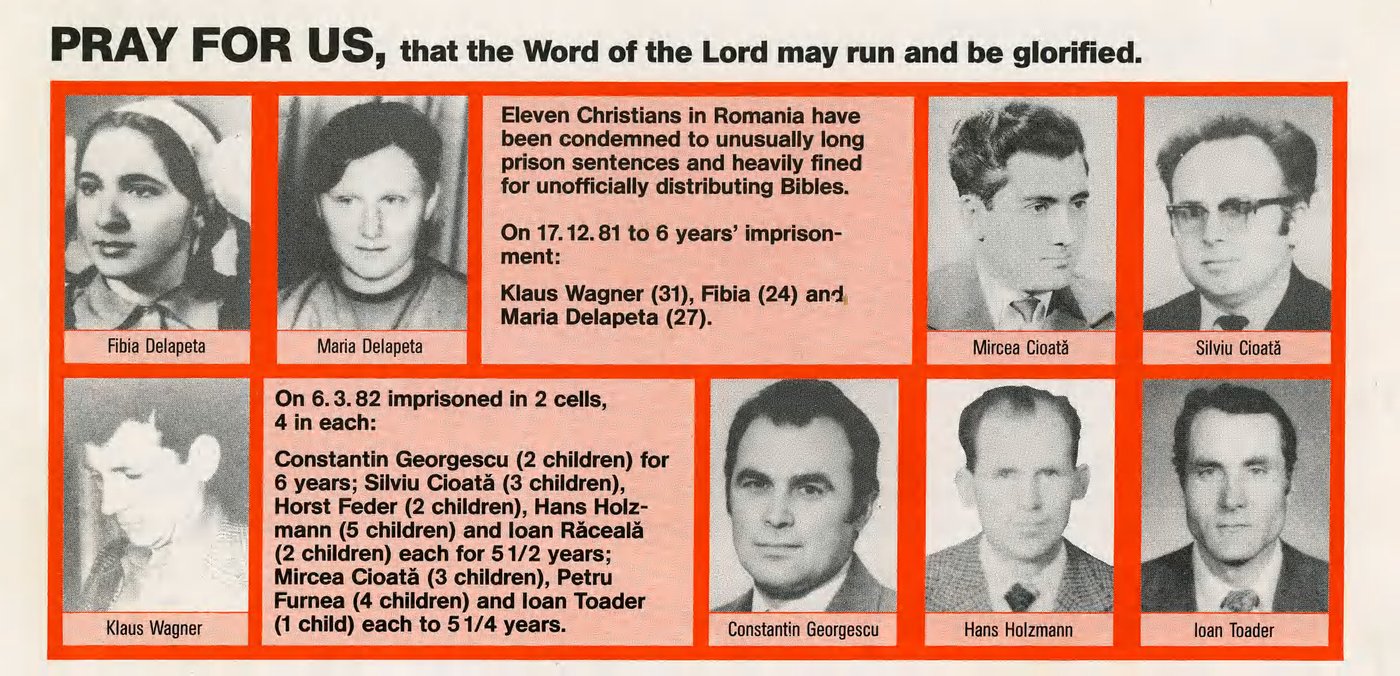
The whole leaflet. Tap here if you want to keep reading.
What the leaflet says
The text, as printed:
Printed leaflet · Keston ml-keston-pho_ro-bre-028-01-02a
PRAY FOR US, that the Word of the Lord may run and be glorified.
Eleven Christians in Romania have been condemned to unusually long prison sentences and heavily fined for unofficially distributing Bibles.
On 17.12.81 to 6 years’ imprisonment: Klaus Wagner (31), Fibia (24) and Maria Delapeta (27).
On 6.3.82 imprisoned in 2 cells, 4 in each: Constantin Georgescu (2 children) for 6 years; Silviu Cioată (3 children), Horst Feder (2 children), Hans Holzmann (5 children) and Ioan Răceală (2 children) each for 5 1/2 years; Mircea Cioată (3 children), Petru Furnea (4 children) and Ioan Toader (1 child) each to 5 1/4 years.
Under the photographs: Fibia Delapeta · Maria Delapeta · Mircea Cioată · Silviu Cioată · Klaus Wagner · Constantin Georgescu · Hans Holzmann · Ioan Toader
The eleven, according to the leaflet
The names are written as on the leaflet. The columns on the right set beside them what Dorin Dobrincu’s study says, already cited on the panel page, and how Florentin Clipa’s panel, part 10, spells the name. Shaded cells show where they do not match. I do not choose between them.
| Name, as on the leaflet | Day, on the leaflet | Term, on the leaflet | Photo on the leaflet | Dobrincu’s study, 2018, p. 178 | Clipa’s panel, part 10 |
|---|---|---|---|---|---|
| Klaus Wagner | 17.12.81 | 6 years | yes | 6 years, of which 5 to be served (sentence no. 1967 of 19 December 1981) | Klaus Wagner |
| Fibia Delapeta | 17.12.81 | 6 years | yes | “Fidia Delapeta”: 6 years, of which 5 to be served (same sentence) | Fidia Delapeta |
| Maria Delapeta | 17.12.81 | 6 years | yes | 6 years, of which 5 to be served (same sentence) | Maria Delapeta |
| Constantin Georgescu | 6.3.82 | 6 years | yes | 6 years (sentence no. 368 of 6 March 1982, Ploiești court) | Costel Georgescu |
| Silviu Cioată | 6.3.82 | 5½ years | yes | 5 years 6 months | Silviu Cioată |
| Horst Feder | 6.3.82 | 5½ years | no | 5 years 3 months | Horst Feder |
| Hans Holzmann | 6.3.82 | 5½ years | yes | “Johann Holzmann”: 5 years 6 months | Johann Holzmann |
| Ioan Răceală | 6.3.82 | 5½ years | no | 5 years 3 months. The 2005 study Dobrincu cites gives no sentence for him; this remains an open question. | Ioan Răceală |
| Mircea Cioată | 6.3.82 | 5¼ years | yes | 5 years 3 months | Mircea Cioată |
| Petru Furnea | 6.3.82 | 5¼ years | no | 5 years 6 months | Petru Furnea |
| Ioan Toader | 6.3.82 | 5¼ years | yes | 5 years 3 months | Ioan Toader |
Where the sources do not match. The leaflet says 17.12.81; the study gives sentence no. 1967 of 19 December 1981. The leaflet says that on 6.3.82 the eight were “imprisoned”; for the same day the study gives sentence no. 368 of the Ploiești court. For Horst Feder, Ioan Răceală and Petru Furnea, the leaflet and the study give different terms. The leaflet writes Fibia and Hans; the study and the panel write Fidia and Johann; the panel writes Costel for Constantin Georgescu. The study also says that ten people were tried in the first trial, and that those sentenced from the Christian Brethren church were freed by Decree no. 200 of 27 July 1982. The leaflet does not know of the release.
One photograph from the Keston collection
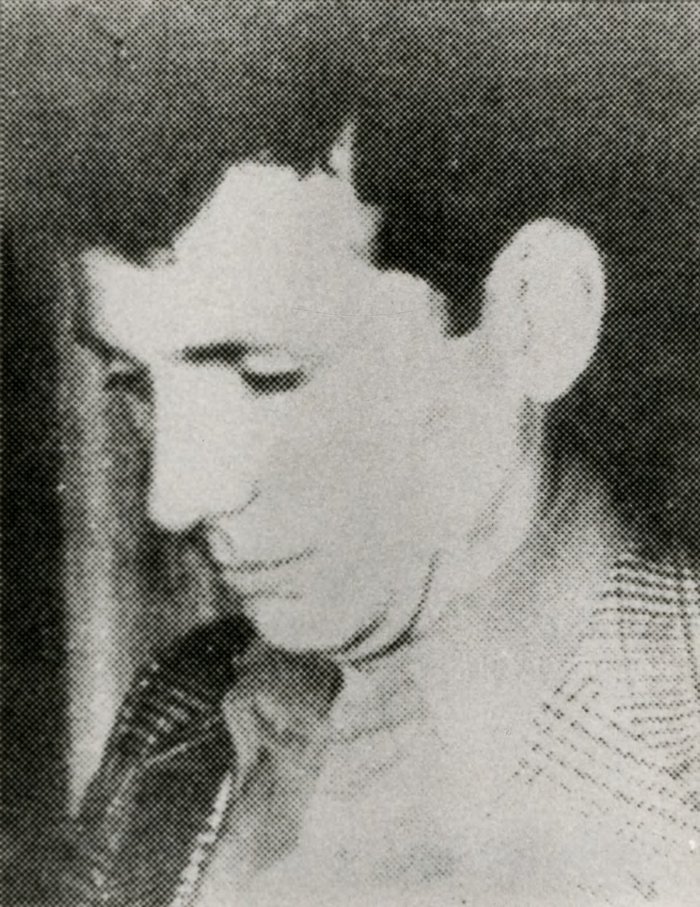
A further Keston portrait is held back for now, pending family consent.
What links this case to Canalul-80, as far as the sources show
- The same Keston collection. Keston files the leaflet, the photograph of Klaus Wagner and the Feder portrait in the same “Romanian Brethren” collection, ml-keston-pho_ro-bre-028, as my father’s portrait and those of the other four from Canalul-80: Paul Gross, Matei Fakner, Mihail Kloos and Manfred Herbert. The Feder label reads “RO/Brethren”, like theirs.
- The same panel. Florentin Clipa’s panel has Canalul 80 as part 8 and Canalul 81 as part 10. Part 10 names the same people, with Klaus Wagner of Sighișoara as the head of the network, and tells of a barge on the Danube. The barge story is the panel’s; the leaflet does not tell it.
- Two cases, not one. The 2005 study by Elis Neagoe-Pleșa and Liviu Pleșa, “Cultele neoprotestante din România în perioada 1975–1989”, pp. 26–27 in the CNSAS copy, and Dorin Dobrincu’s study, at pp. 177–178, which cites it, treat them as separate operations. The 2005 study says that, in the action “Canalul-81,” on 17 September 1981, the Mehedinți county Securitate found a large quantity of religious material brought down the Danube on a barge from West Germany; for the group of eight there followed sentence no. 368 of 6 March 1982 of the Ploiești court. Amnesty International, Report 1982, pp. 288–289, describes the ship and the arrests, but does not use the name “Canalul 81.”
- No one in common. The cover of the Canalul-80 file and the charging act of 30 November 1980, in my father’s archive, name only my father, Paul Gross, Mihail Kloos, Matei Fakner and Manfred Herbert. None of the eleven on the leaflet is among them. I have found no paper in this file that links anyone in one case to the other.
What I do not put here
The same Keston collection has two more photographs of the Feder family with small children. I do not put them on the site. It also has two photographs with no name label, which I have not identified, and a 1982 leaflet about six women arrested in the Soviet Union, which is not about Romania. These are not here either.
What other published sources say
What follows does not come from my father’s file. It comes from sources already in print, each with its citation. Where they do not match, both remain.
The 2005 study by Elis Neagoe-Pleșa and Liviu Pleșa, “Cultele neoprotestante din România în perioada 1975–1989” (pp. 26–27 in the CNSAS PDF copy; printed in Adrian Nicolae Petcu, ed., Partidul, Securitatea și cultele, 1945–1989, Bucharest, Nemira, 2005), is the study Dobrincu cites. It places Klaus Wagner and the Delapeta sisters in the first trial, of ten people, three of them members of the Christian Brethren. It has the other eight tried at the Ploiești court, sentence no. 368 of 6 March 1982; the appeals were rejected by Decision no. 193 of 11 March 1982 of the Prahova County Tribunal. For the six-year terms, the study says that, under Decree no. 189/1981, five years were to be served. It accuses the eight of having, from 1978, carried and distributed religious literature and household appliances, on charges of complicity in smuggling (Law no. 30/1978) and unauthorised distribution of printed and sound materials (Press Law no. 3/1974).
Liviu Georgescu, the son of Constantin Georgescu, writes that most were released on 30 July 1982, and his father on 31 July. The release decree, no. 200, is dated 27 July 1982, as the 2005 study also says. Liviu’s account was published by Istorie Evanghelica, 1 August 2022, and, in a longer form, at ZTB.ro, 9 October 2025. Amnesty International, Report 1983, p. 273, writes, of Dr Silviu Cioată and the other seven tried at Ploiești, that in August it was reported that all eight had been pardoned and released.
- Klaus Wagner. The 2005 study, p. 26, and Amnesty International, Report 1982, pp. 288–289, give him as from Sighișoara, a member of the Christian Brethren. The report “Truths Which Cannot Be Hidden,” printed in Religion in Communist Lands 10:2 (1982), p. 225 and already on the Truths page, says he was arrested on 1 October 1981 and that his house was searched without a warrant; among the things taken, a cassette recorder. Amnesty writes “at the beginning of October,” after a ship with Bibles docked at Turnu Severin at the end of September. Amnesty received allegations that, after his arrest, he was so badly beaten by the police that by early November he was still under intensive care in hospital, and that neither he nor the Delapeta sisters were allowed access to defence counsel during the investigation. On 17 December, Amnesty writes, he was sentenced to six years, on charges of complicity in bringing contraband into Romania. Liviu Georgescu writes that he collected him, on 30 July 1982, from Gara de Sud in Bucharest, that he noticed missing teeth and a face that said he had been through a hard interrogation, and that Wagner left the same day for Sighișoara, to his wife and four children. (The leaflet gives his age, not a number of children.)
- Fibia Delapeta and Maria Delapeta. Amnesty, Report 1982, pp. 288–289, and ALRC in RCL 10:2, p. 225, give them as from Cărpiniș, Hunedoara county, and give each a five-year term, not six. Amnesty writes that they were members of the Lord’s Army (Oastea Domnului), a group of the Romanian Orthodox Church which was not officially recognized. The 2005 study, p. 26, places them instead in the Christian Brethren, the church for which the material was intended. Liviu Georgescu writes that they were nieces of Valer Irinca, of the Lord’s Army, and that they were held at Craiova. Both descriptions remain; I do not choose between them. Amnesty writes that, during the investigation, they had no access to defence counsel.
- Constantin Georgescu. The 2005 study, p. 27, gives him as from Ploiești and, with Silviu Cioată, names him as a leader of the group of eight. It says he was presented, in May 1979, on Radio Free Europe as persecuted for belonging to the Christian Brethren, and that he was warned by the Securitate on 14 June 1980. Bogdan Emanuel Răduț, in Istorie Evanghelica, 1 August 2022, gives his year of birth as 1939. Liviu Georgescu, his son, writes that his father was released on 31 July 1982, a day after the others, after a release wrongly announced on the 30th.
- Silviu Cioată. The 2005 study, p. 27, gives him as from Ploiești and, with Georgescu, names him as a leader of the group. It says he had been warned by the Securitate in 1971 and in 1976, and that in 1977, with Iosif Țon and others, he wrote a text broadcast by Radio Free Europe; the investigation did not go to trial, but to a public debate on 4 April 1977 and a denunciation in the local press on 9 April 1977. Amnesty, Report 1982, pp. 288–289, gives him, with his brother Mircea, as from Ploiești, of the Christian Brethren. Report 1983, p. 273, calls him “Dr Silviu Cioata, a preacher of the Brethren Church” and an adopted prisoner of conscience, and says that in March a court in Ploiești sentenced him and seven others to terms of between five and six years, for violating customs and press laws by distributing Bibles. His membership of ALRC, which Amnesty states in both reports, remains as that source gives it, not checked here against an ALRC list. Răduț, in Istorie Evanghelica, 2022, gives his years as 1931–1997.
- Horst Feder. The 2005 study, p. 27, gives him as from Sighișoara and gives him five years three months. Liviu Georgescu writes that he was released on 30 July 1982 from I.L. Caragiale prison and that, the same day, he came, with Hans Holzmann, to the Georgescu home in Ploiești, to wait for the families’ cars.
- Hans Holzmann. The 2005 study, p. 27, writes “Ioan Holzman,” from Brașov, and gives him five years six months. Liviu Georgescu calls him Hans Holzmann and writes that he was released on 30 July 1982 from Caragiale, and that he waited, with Feder, at the Georgescu home.
- Ioan Răceală. The 2005 study, p. 27, names him among the eight, with no hometown and no sentence: “Nu deținem date despre pedeapsa primită de Ioan Răceală.” The five years three months given by Dobrincu is not in the study he cites. Răduț, in Istorie Evanghelica, 2022, also leaves him out of the sentence list. The 1982 leaflet remains, among the printed sources seen here, the only one that gives him a term: 5½ years. Liviu Georgescu writes “Ion Raceala (adventists)” among those released on 30 July 1982 from Caragiale. The 2005 study lists him among eight members of the Christian Brethren. The affiliation remains an open question.
- Mircea Cioată. The 2005 study, p. 27, gives him as from Ploiești, brother of Silviu, and gives him five years three months. Amnesty, Report 1982, pp. 288–289, gives him, with Silviu, as of the Christian Brethren, from Ploiești. ALRC, in RCL 10:2, p. 225, says he was arrested in Ploiești on 10 November 1981, together with Silviu Cioată, Toader Nelu and Petru Furnea (printed “Petru Furner”). Răduț, in Istorie Evanghelica, 2022, gives his year of birth as 1933. Liviu Georgescu writes that he was released on 30 July 1982 from Caragiale.
- Petru Furnea. The 2005 study, p. 27, gives him as from Ploiești and gives him five years six months. ALRC, in RCL 10:2, p. 225, names him, spelled “Petru Furner,” among those arrested in Ploiești on 10 November 1981 and sentenced to more than five years. Răduț, in Istorie Evanghelica, 2022, gives his year of birth as 1933. Liviu Georgescu calls him Petrica Furnea and writes that he was released on 30 July 1982 from Caragiale.
- Ioan Toader. The 2005 study, p. 27, gives him as from Ploiești and gives him five years three months. ALRC, in RCL 10:2, p. 225, calls him “Toader Nelu, an engineer,” arrested in Ploiești on 10 November 1981. Răduț, in Istorie Evanghelica, 2022, gives his years as 1940–2012. Liviu Georgescu calls him Nelu Toader and writes that he was released on 30 July 1982 from Caragiale.
Inferences, not confirmed facts
The leaflet’s year. The leaflet has no printing date. The latest day in the text is 6.3.82, so it was printed in 1982 or later, before news of the release. Our inference.
The photograph of Klaus Wagner. Keston item 10-01 has no name label. We name it from the identical photo on the leaflet. Our inference, from comparing the two images.
The name “Canalul 81”. The leaflet does not use this name. Dorin Dobrincu’s study and Florentin Clipa’s panel do.
Open questions
- Who printed the leaflet, and when? The scanned page does not say.
- When, and from whom, did the leaflet and the photographs reach Keston?
- What are the terms in the judgments for Horst Feder, Ioan Răceală and Petru Furnea? The leaflet and the study do not match.
- 17 or 19 December 1981? The leaflet and the study give different days.
How to cite
Leaflet “PRAY FOR US, that the Word of the Lord may run and be glorified”, printed in English, undated [1982]. Source: Keston Center for Religion, Politics and Society, Baylor University, collection “Photographs of Members of Christian Evangelical Church of Romania (Romanian Brethren)”, ml-keston-pho_ro-bre-028-01-02a. The photograph of Klaus Wagner: same collection, ml-keston-pho_ro-bre-028-10-01, undated, no name label. Baylor Digital Collections. The study: Dorin Dobrincu, “Sub puterea Cezarului. O istorie politică a evanghelicilor din România (a doua jumătate a secolului al XIX‑lea – 1989)”, in Dorin Dobrincu, Dănuț Mănăstireanu (eds.), Omul evanghelic, Iași, Polirom, 2018, pp. 177–178.