Hofman Fund · Canalul-80 · Keston, 1981
Back to the archive · Documents from the file · Canalul-80
Keston News Service no. 115, 15 January 1981
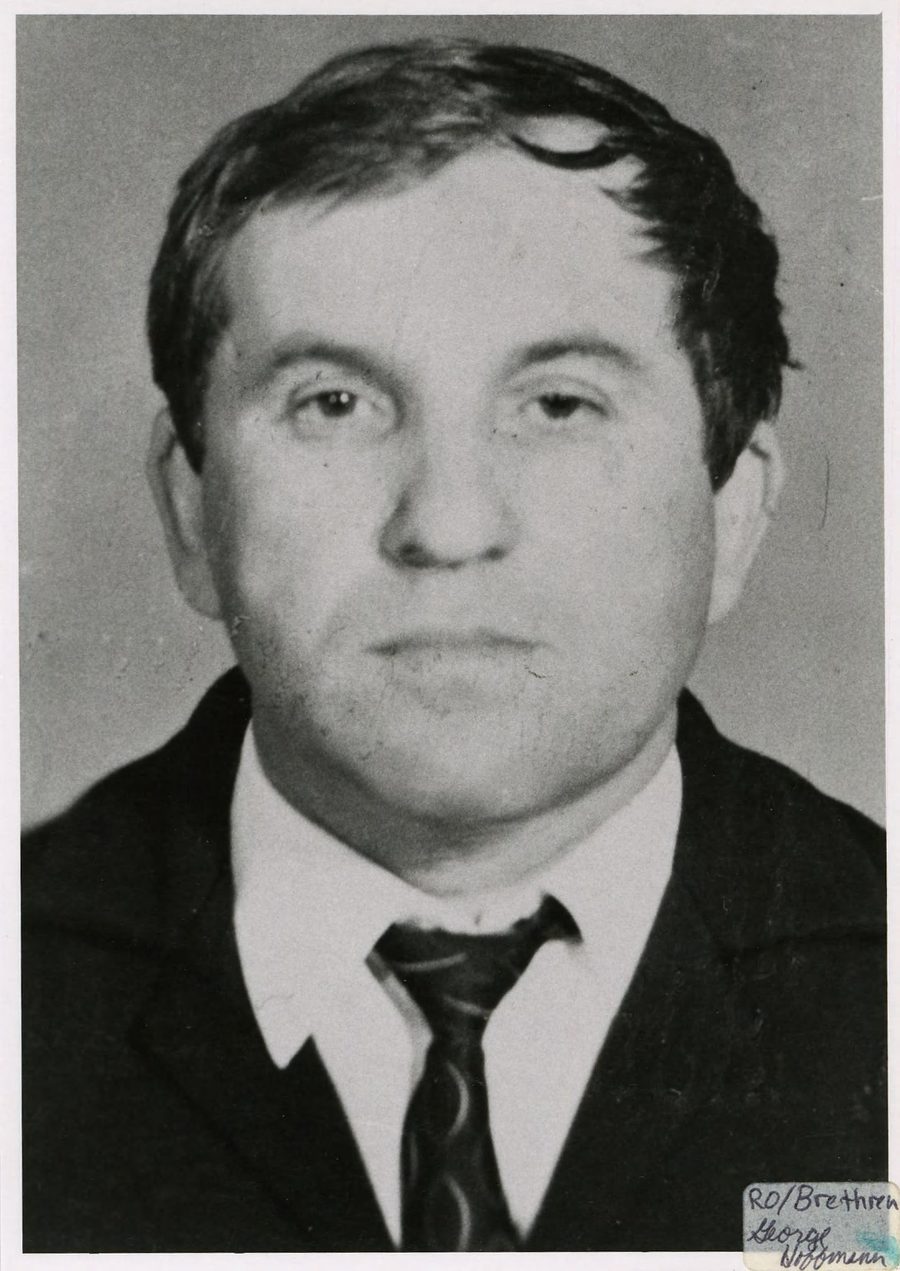
On 15 January 1981, Keston College, in England, printed in its news bulletin a summary of the arrests of believers in autumn 1980 over Bibles. It names my father, Gheorghe Hofman. It is a Western press report, not a court record. I set it beside the family papers. The family papers stay above it.
Source: Keston College, Keston News Service, no. 115, 15 January 1981, 8 pages; the article “Romanian Christian Committee Issues Disturbing Reports” on pp. 3–4; my father on p. 4. The digital copy: Keston Center for Religion, Politics and Society, Baylor University, ml-keston-doc_kns_1981-115. The images below are reduced for the web. The full scans are at Baylor: p. 3 · p. 4.
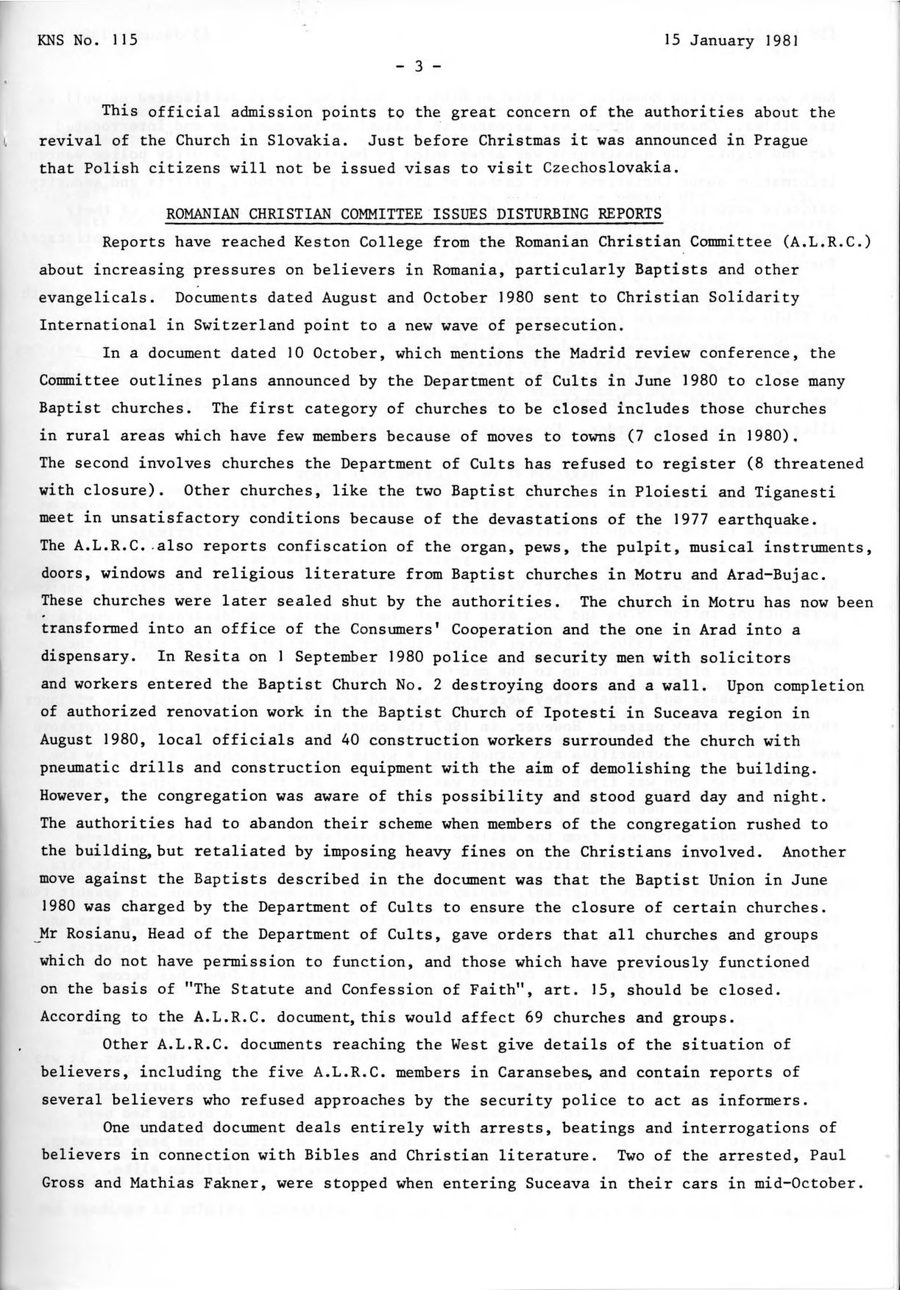
The whole page. Tap here if you want to keep reading.
What the report says
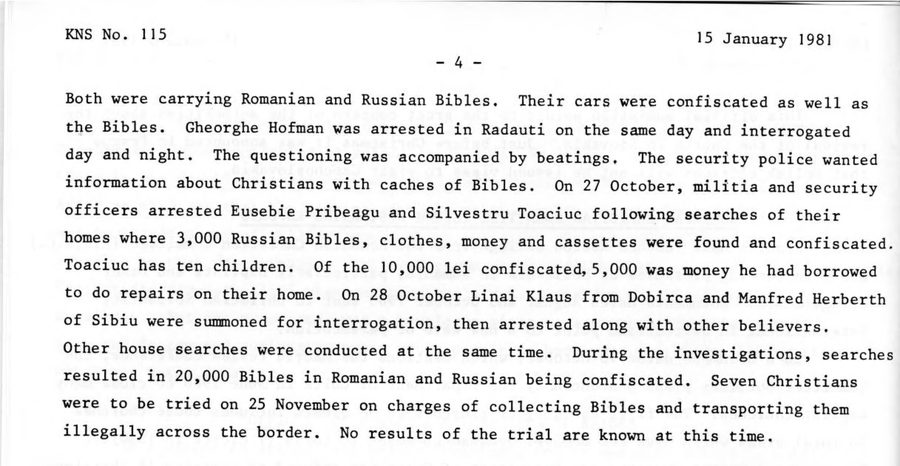
The passage about my father, as printed. The bulletin writes “Radauti” without diacritics.
Keston News Service no. 115 · pp. 3–4
Two of the arrested, Paul Gross and Mathias Fakner, were stopped when entering Suceava in their cars in mid-October.
Both were carrying Romanian and Russian Bibles. Their cars were confiscated as well as the Bibles. Gheorghe Hofman was arrested in Radauti on the same day and interrogated day and night. The questioning was accompanied by beatings. The security police wanted information about Christians with caches of Bibles.
“On the same day” is the day Paul Gross and Matei Fakner (“Mathias Fakner” in the bulletin) were stopped entering Suceava, “in mid-October.” Further on, the report says that on 27 October Eusebie Pribeagu and Silvestru Toaciuc were arrested after searches in which 3,000 Russian Bibles were found. It says that on 28 October “Linai Klaus from Dobirca” and Manfred Herbert (“Manfred Herberth” in the bulletin) of Sibiu were summoned for interrogation and then arrested. It says 20,000 Bibles in Romanian and Russian were confiscated during the investigations, and that seven Christians were to be tried on 25 November, on charges of collecting Bibles and taking them illegally across the border. Its last sentence: “No results of the trial are known at this time.”
Those arrested · the Keston photographs
The same Keston collection as my father’s portrait, “Photographs of Members of Christian Evangelical Church of Romania (Romanian Brethren)”, ml-keston-pho_ro-bre-028, holds four portraits labelled with the names of the other four in the charging act of 30 November 1980: Gross Paul, Fakner Matei, Kloos Mihail and Herbert Manfred. With my father, they are the five sent to trial. Under each portrait the name is spelled as in the CNSAS papers; the Keston label stands beside it, in quotation marks, copied letter for letter. The photographs are undated. We do not know who took them or when they reached Keston.
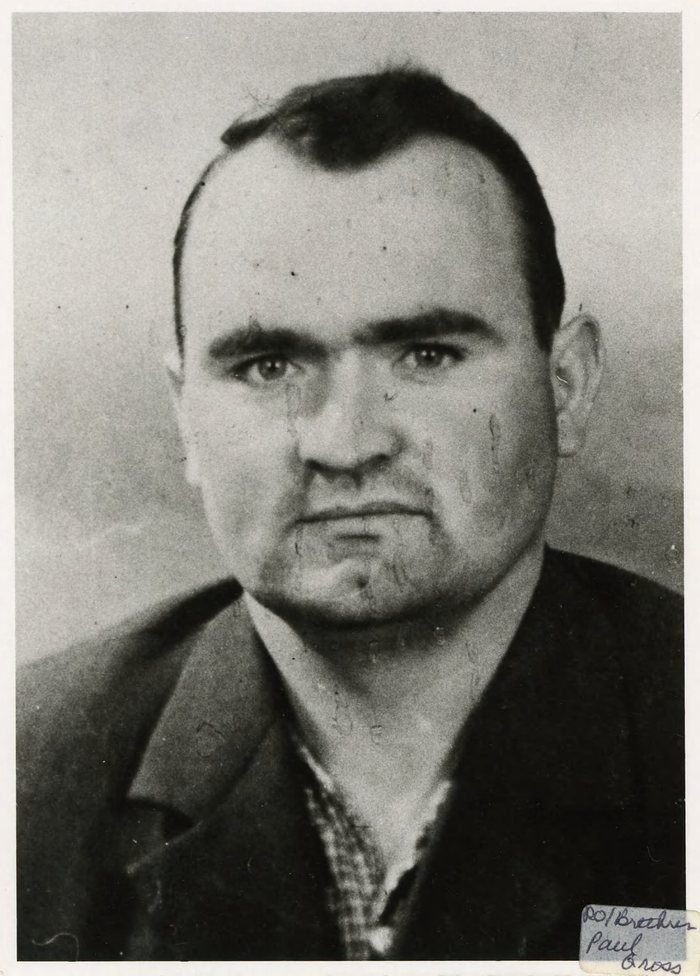
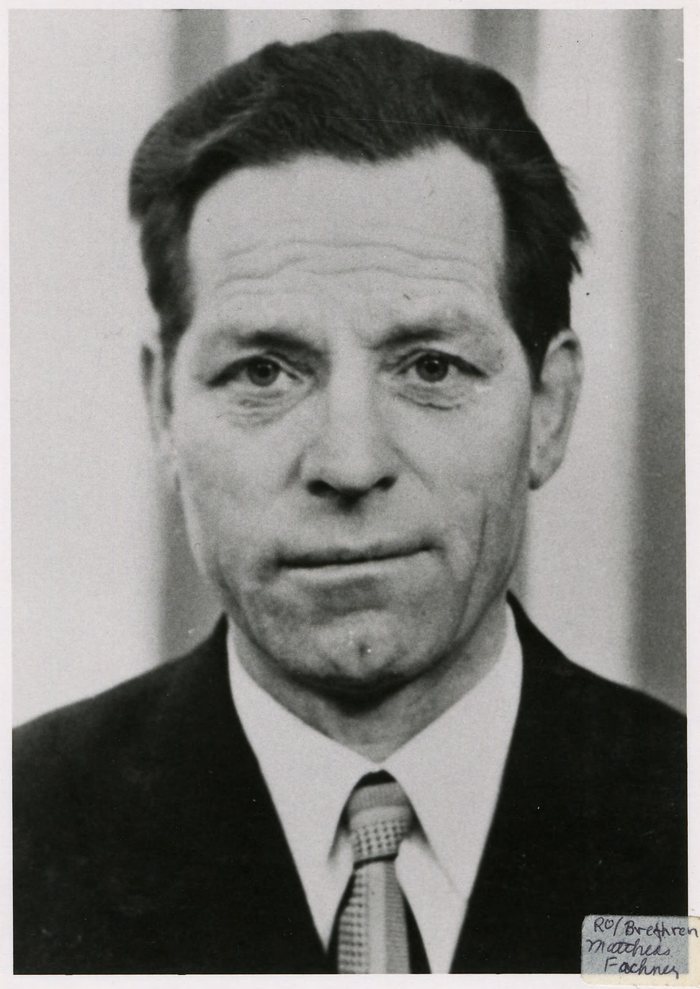
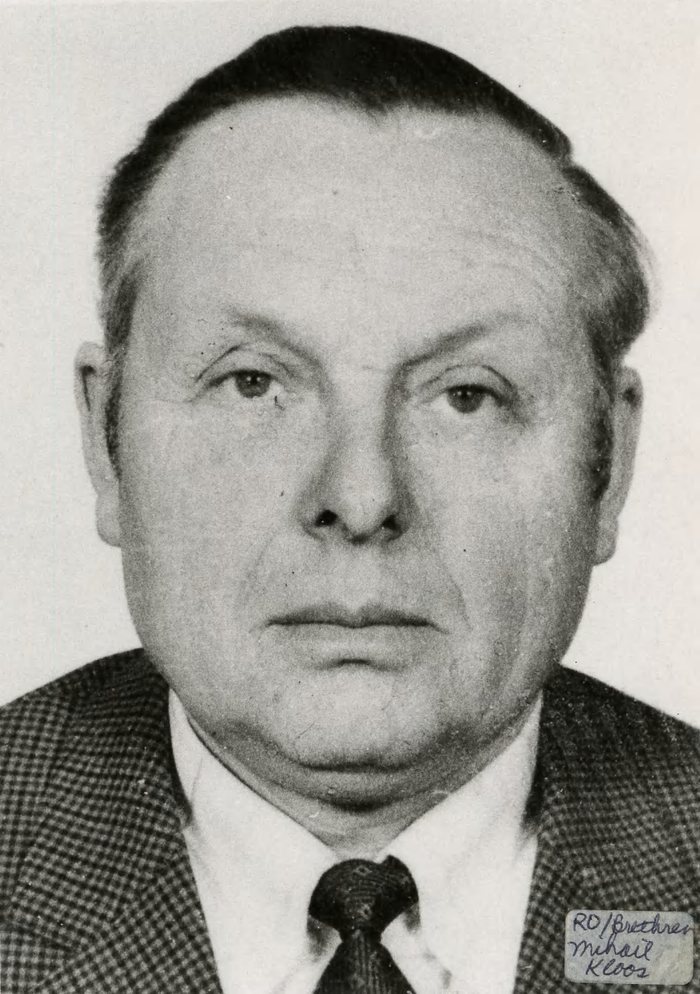
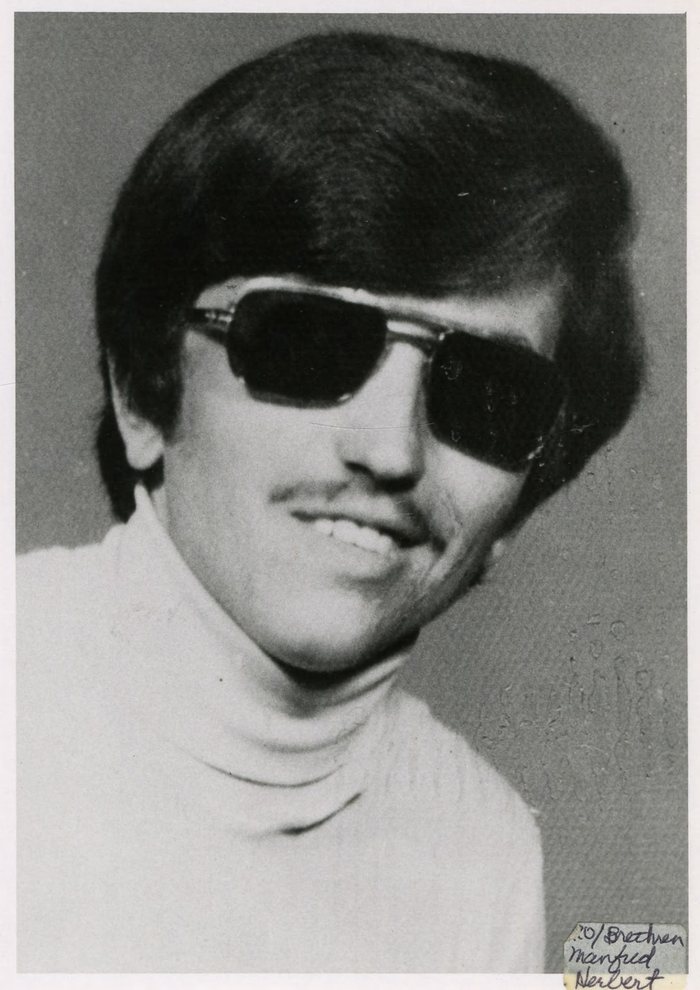
The labels spell the names differently from the papers. “Fachner” and “Mihaïl” are the labels’ spellings. The charging act writes Fakner Matei, Kloos Mihail and Herberth Manfred. Under the photographs stands the spelling of the CNSAS list, which writes Herbert, like the label. The labels stay quoted, as do the spellings in the names table. On Manfred’s label the first letter is cut off by the edge.
What is not in the collection. There is no photograph labelled Eusebie Pribeagu or Silvestru Toaciuc, whom the report names as arrested on 27 October. The other photographs in the collection belong to a different case, the one of 1981–1982, or carry no name label. I do not show them here.
Editorial note, 11 November 2026. The names under the portraits follow the CNSAS list “Tabel cu persoanele luate în evidență” (table of persons taken into record; folio not yet confirmed), which writes them Fakner Matei, Gross Paul, Herbert Manfred, Hofman Gheorghe and Kloos Mihail. The CNSAS papers take precedence over the Keston labels. So “Matthias Fachner” becomes Matei Fakner and “Mihaïl Kloos” becomes Mihail Kloos; Paul Gross and Manfred Herbert were already spelled as in the list. The cover of CNSAS file P 039192, vol. 1, and the charging act in the same volume write “Herberth”, with an h; the folio is not yet confirmed for either. The Keston labels stay quoted, as a 1981 source.
Editorial note, 11 November 2026. The portraits on this page, like the Keston News Service pages, come from the collections of the Keston Center for Religion, Politics and Society, Baylor University. From 11 November 2026 the captions on this page said “Courtesy of the Keston Center…”. That was our wording, not Keston’s; they now say “Source:”. No formal rights arrangement exists. The photographs are used with the family’s approval and are credited to Keston as the source.
What it is and what it is not
Keston College, in Keston, Kent, England, gathered news about believers in Communist countries. Keston News Service was its news bulletin. Issue 115 has eight pages.
The article on pp. 3–4 summarises documents received from the Romanian Christian Committee (A.L.R.C.) and sent to Christian Solidarity International, in Switzerland. The passage about my father comes from a single undated document. Keston writes that this document “deals entirely with arrests, beatings and interrogations of believers in connection with Bibles and Christian literature.”
It is not a court record. It is not a page signed by my father. It is what reached the West three months after the arrest, before the sentence was known. That is why its lines are read as “a 1981 report says.”
The door What others wrote also holds a text by the same committee, reprinted by Keston in 1982: “Truths Which Cannot be Hidden.” That one speaks of a trial in Botoșani and of two to three years. Botoșani was the prison. KNS 115 is older and does not yet know of a trial.
Beside the family papers
The family papers come first. The report is not corrected. It is set beside them.
| Family papers | The CNSAS study and Dobrincu | KNS 115 · a 1981 report says | |
|---|---|---|---|
| My father’s arrest | The criminal investigation begins on 25 October 1980. Warrant no. 337/B/1980, of 26 October 1980. Pre-trial arrest from 31 October 1980. | The Suceava Militia checkpoint, the night of 18/19 October 1980 (study, p. 24). It does not give the day of his arrest. | arrested in Rădăuți “on the same day” as the Suceava stop, “in mid-October”; interrogated day and night |
| Beatings | I have no page in the house, signed by him, that says so. | not in this passage | “The questioning was accompanied by beatings.” The report’s sentence. |
| The trial | Criminal sentence no. 13 of 10 January 1981, Rădăuți court (Judecătoria Rădăuți), file 3339/1980. Appeal rejected on 31 January 1981 by the Suceava County Tribunal, Criminal Decision no. 49, file 161/1981. Botoșani was the prison. | a trial at Suceava, from 25 November 1980 (p. 25); sentence no. 13 of 10 January 1981 (p. 26) | seven Christians “were to be tried on 25 November”; no court named; the result not known |
| The sentence | Decision no. 49, the typed copy photographed at home: one year and six months. Unconfirmed until the CNSAS certified copy of sentence no. 13 (P 2551/2026). | a term for Paul Gross only (p. 26) | gives no sentence |
| Bibles | Decision no. 49, for him: 29 printed items, 25 recorded items and a cassette player. It gives no number of Bibles. | 576 Russian Bibles in the two cars (study, p. 24). 2,719 Bibles in 21 house searches by 31 October 1980 (Dobrincu, 2018, p. 177). | 3,000 Russian Bibles at two homes, on 27 October; “20,000 Bibles in Romanian and Russian” across the investigations |
| Dobirca | The charging act of 30 November 1980 writes, for Kloos Mihail, the village of Dobârca, in Miercurea Sibiului. A working reading of the photograph. | Mihail Kloos, “din com. Miercurea Sibiului, jud. Sibiu” (p. 25) | “Linai Klaus from Dobirca”, summoned on 28 October, then arrested |
| 25 November 1980 | The reference from the committee of the Rădăuți assembly. A paper of the assembly, not the day of the trial. | “a trial at Suceava, from 25 November 1980” (p. 25) | the date the trial was expected |
Three papers carry the date 25 November 1980: the Rădăuți assembly’s reference, the CNSAS study and the Keston report. I do not merge them. The assembly’s reference is not the trial. The KNS date is an expectation, not a proven hearing. The sentence came on 10 January 1981, at the Rădăuți court.
Hypotheses, not confirmed facts
“Linai Klaus from Dobirca” would be Kloos Mihail. Our hypothesis. Dobirca resembles Dobârca, the village the charging act writes for Kloos Mihail. The CNSAS study gives Mihail Kloos of Miercurea Sibiului commune. The report does not write Kloos. I do not turn “Linai Klaus” into a new person.
“The same day” would be around 18/19 October 1980. Our inference: the report writes “mid-October,” and the study places the Suceava checkpoint on the night of 18/19 October. In his film, my father says the local policeman took him to Suceava on a Monday; the Monday after 18 October 1980 is 20 October. That is his testimony, not the file. The file holds the warrant of 26 October and the pre-trial arrest from 31 October. I write all of them.
The 20,000 Bibles. The figure is the report’s, for all the investigations. I do not add it to 576 or 2,719, and I do not choose between them.
Open questions
- The undated ALRC document, as its own text. Where is it? Perhaps in the Keston folders at Baylor, Box 4 F7 and Box 17 F9, not yet opened here.
- Did a later issue of Keston News Service report the sentence of 10 January 1981?
- Who are the “seven” who were to be tried? The CNSAS study counts five sentenced.
- What was 25 November 1980, for the report and for the study? The assembly’s reference, of the same day, does not answer that.
How to cite
Keston College, Keston News Service, no. 115, 15 January 1981, pp. 3–4, “Romanian Christian Committee Issues Disturbing Reports”; Gheorghe Hofman on p. 4. Source: Keston Center for Religion, Politics and Society, Baylor University. Baylor Digital Collections, ml-keston-doc_kns_1981-115. The portrait: Keston Center, Baylor University, ml-keston-pho_ro-bre-028-07-01, undated. The other four: the same collection, items 05-01 (Paul Gross; label “Paul Gross”), 03-01 (Matei Fakner; label “Matthias Fachner”), 08-01 (Mihail Kloos; label “Mihaïl Kloos”) and 06-01 (Manfred Herbert; label “Manfred Herbert”), undated. Names as in the CNSAS papers; labels quoted.