
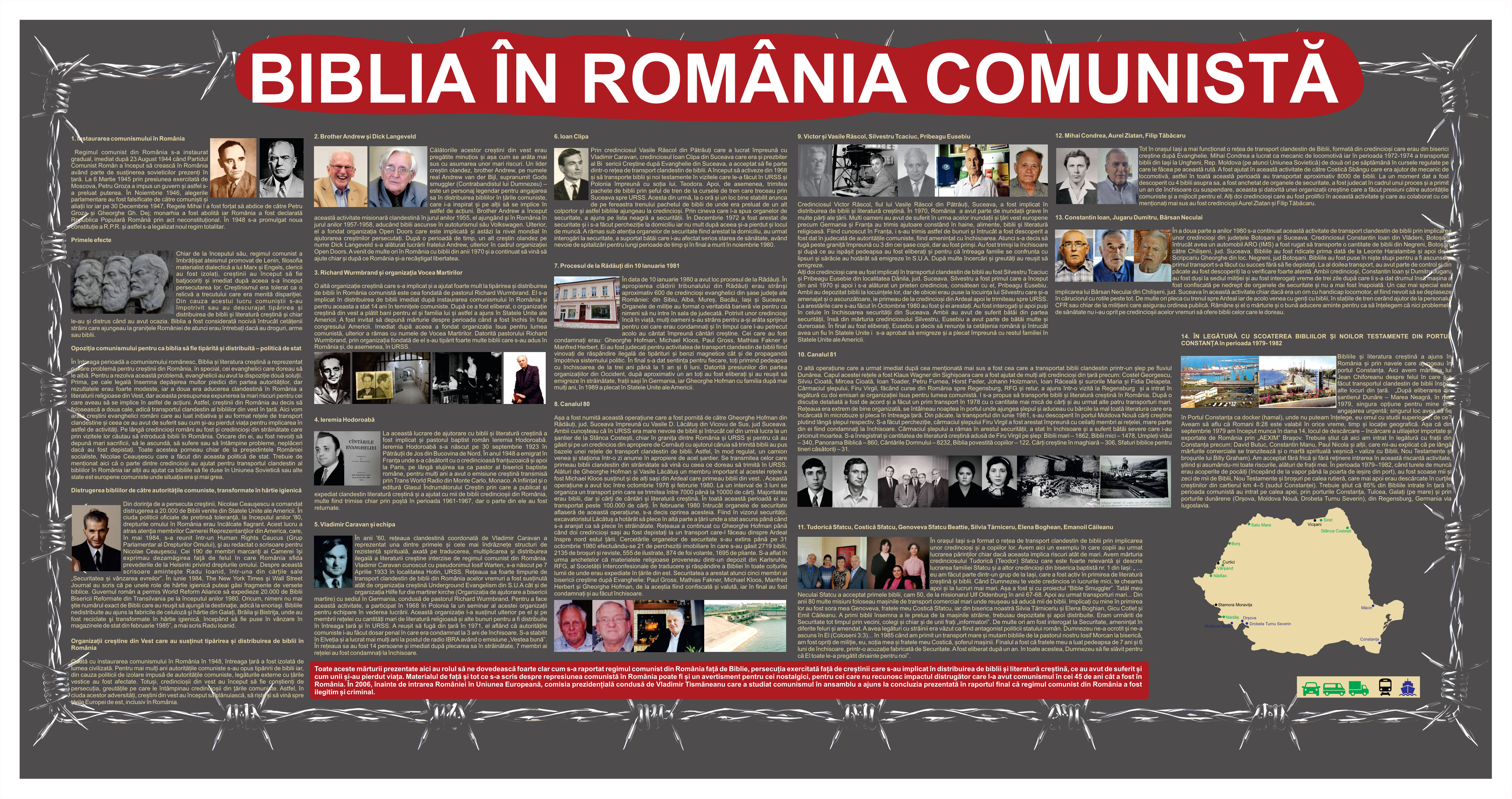
BIBLIA ÎN ROMÂNIA COMUNISTĂ (The Bible in Communist Romania)

Florentin Clipa · 2026

The author is Florentin Clipa. The words are his, from the panel sent to the archive on 28 October 2026. The photographs are cropped from the same panel and set into chapters, so they can be read. Tap a photograph to enlarge it. The files are the panel’s own pixels. A few portraits were already small there.

This English text is a Hofman Fund translation of his Romanian words. The original is the Romanian page. Where the English and the Romanian differ, the Romanian is his.

The short page

This is Florentin Clipa’s panel, sent to the archive on 28 October 2026. The words and the photographs are his.

My father, Gheorghe Hofman, is named in part 8, Canalul 80. The sentence is Florentin Clipa’s.

Open the part about my father.

The whole panel. Tap here if you want every part.

1 The establishment of communism in Romania

The communist regime in Romania was established gradually, right after 23 August 1944, when the Romanian Communist Party began to grow in Romania with the support of the Soviets present in the country. On 6 March 1945, through pressure from Moscow, Petru Groza imposed a government, and so power was taken. In November 1946 the parliamentary elections were falsified by the communists and their allies, and on 30 December 1947 King Mihai I was forced to abdicate by Petru Groza and Gheorghe Gh. Dej; the monarchy was abolished and Romania was declared the Romanian People’s Republic by an unconstitutional act. In 1948 the new constitution of the R.P.R. was promulgated, and so the new totalitarian regime was legalized.

From its very beginning, the communist regime embraced the atheism promoted by Lenin and the dialectical materialist philosophy of Marx and Engels; the clergy were isolated, Christians began to be mocked, and right after that their persecution began. Christianity was tolerated as a relic of the past that was destined to disappear. Because of this, the communists opposed or discouraged the printing and distribution of Bibles and Christian literature, and even destroyed them when they had the chance. The Bible was considered harmful, since foreign citizens who reached the borders of Romania at that time were asked whether they had drugs, weapons or Bibles.

Throughout the whole period of Romanian communism, the Bible and Christian literature were a great problem for the Christians in Romania who wanted to have them, especially the evangelicals. To solve this problem, the evangelicals had two solutions. The first, the legal way, meant overcoming many obstacles put up by the authorities, but the results were very modest; the second was bringing religious literature into Romania clandestinely from the West, but that meant great risks for those who would take part in such actions. So the Christians in Romania decided to use the second way, that is, the clandestine transport of Bibles from the West into the country. Here we will show Romanian evangelical Christians who took the initiative and formed clandestine transport networks, and what they had to suffer, or how they lost their lives, for taking part in such activities. Besides Romanian believers, there were also believers from abroad who, through their visits, tried to bring Bibles into Romania. Every one of them had to make great sacrifices, to hide the Bibles, to suffer, or to meet problems and troubles if they were found out. All of this came from the president of socialist Romania himself, Nicolae Ceaușescu, who made it state policy. It must be mentioned here that some of the believers helped with the clandestine transport of Bibles into Romania, and others helped to get the Bibles taken into the Soviet Union or other communist states of Eastern Europe, where the situation was even harder.

Out of a desire to persecute Christians, Nicolae Ceaușescu ordered the destruction of 20,000 Bibles that had come from the United States of America. Despite the official policy of so-called tolerance, at the beginning of the '80s human rights in Romania were being flagrantly violated. This drew the attention of members of the American House of Representatives, who in May 1984 met in a Human Rights Caucus and drafted a letter to Nicolae Ceaușescu. The 190 prominent members of the House expressed their disappointment at the way Romania defied the Helsinki provisions on human rights. Radu Ioanid mentions this letter in one of his books, „Securitatea și vânzarea evreilor” [The Securitate and the Sale of the Jews]. In June 1984, The New York Times and the Wall Street Journal wrote that on some rolls of toilet paper you could find fragments of Bible verses. The Romanian government allowed the World Reform Aliance to send 20,000 Bibles to the Reformed Church in Transylvania around the beginning of the 1980s. In any case, no one knows any more the exact number of Bibles that managed to reach their destination, that is, the parishioners. The undistributed Bibles ended up at the pulp and paper mills in Galați, Brăila and Bistrița, where they were recycled and turned into toilet paper, which began to be put on sale in the state shops from February 1985”, Radu Ioanid also wrote.

With the establishment of communism in Romania in 1948, the whole country was isolated from the civilized world. For many years the communist authorities opposed the printing of Bibles, and because of the policy of isolation imposed by the communist authorities, external ties with Western countries were affected. Even so, believers in the West began to become aware of the persecution and the hardships that believers in the communist countries were facing. And so, despite these adversities, Christians from the West began to plan, to take risks, and to come to the countries of Eastern Europe, including Romania.
2 Brother Andrew and Dick Langeveld

The journeys of these Western Christians were prepared meticulously and, as shown above, with great risks taken on. A Dutch Christian leader, brother Andrew, whose real name is Andrew van der Bijl, nicknamed Gods smuggler (God’s Smuggler) – is a legendary figure for his commitment to distributing Bibles in the communist countries, which also inspired others to take part in such actions. Brother Andrew began this clandestine missionary activity around 1955, and he also reached Romania around 1957-1958, bringing Bibles hidden in his Volkswagen car. Later he founded the organization Open Doors, which is still involved worldwide today in helping persecuted Christians. After a time, another Dutch Christian named Dick Langeveld joined brother Andrew’s work, later within the organization Open Doors. He came to Romania with Bibles many times from the 1970s, and he kept coming to help even after Romania regained its freedom.

3 Richard Wurmbrand and the Voice of the Martyrs organization

Another Christian organization that took part and helped a great deal with printing and distributing Bibles in communist Romania is the one founded by pastor Richard Wurmbrand. He became involved in distributing Bibles right after the establishment of communism in Romania, and for this he spent 14 years in the communist prisons. After he was released, a Christian organization in the West paid money for him and his family, and so he reached the United States of America. He was invited to testify before the American Congress about the period when he was imprisoned. Right after that he founded the organization Jesus to the Communist World, which later kept the name the Voice of the Martyrs. Thanks to pastor Richard Wurmbrand, through the organization he founded, a great many Bibles were printed and brought into Romania and also into the USSR.

4 Ieremia Hodoroabă

The Romanian Baptist pastor Ieremia Hodoroabă also took part in this work of helping with Bibles and Christian literature. Ieremia Hodoroabă was born on 30 September 1923 in Pătrăuții de Jos, in Northern Bukovina. In 1948 he emigrated to France, where he married a French believer, and then in Paris, besides his ministry as pastor of the Romanian Baptist church, for many years he had a Christian broadcast transmitted by Trans World Radio from Monte Carlo, Monaco. He also founded a publishing house, Glasul Îndrumătorului Creștin, through which he published and clandestinely sent Christian literature, and he helped the believers in Romania with thousands of Bibles, many of them sent even by post in the period 1961-1967, though some of them were returned.

5 Vladimir Caravan and his team

In the '60s, the clandestine network coordinated by Vladimir Caravan was one of the first and boldest structures of spiritual resistance, focused on translating, multiplying and illegally distributing the Christian literature banned by the communist regime in Romania. Vladimir Caravan, known by the pseudonym Iosif Warten, was born on 7 April 1933 in Hotin, USSR. His very early network for the clandestine transport of Bibles in the Romania of those times was supported both by the Christian organization Underground Evangelism of the U.S.A. and by the organization Hilfe fur die martirer kirche (the Organization for Aid to the Martyr Church), based in Germany and led by pastor Richard Wurmbrand. To do this work, in 1968 he took part in a seminar of this organization in Poland, to be equipped for the work. This organization later supported him and the members of the network with large quantities of religious literature and other goods to be distributed across the whole country and in the USSR. He managed to flee the country in 1971, having learned that the communist authorities had opened a criminal file on him in which he was sentenced to 3 years in prison. He settled in Switzerland and worked for many years at the radio station IBRA, with a programme called „Vestea bună” [The Good News]. There were 14 people in his network, and right after he left for abroad, 7 members of the network were sentenced to prison.

6 Ioan Clipa

Through the believer Vasile Răscol of Pătrăuți, who worked together with Vladimir Caravan, the believer Ioan Clipa of Suceava, who was also a presbyter of the Christian Church according to the Gospel in Suceava, agreed to be part of a network for the clandestine transport of Bibles. He began to be active from 1968 and to carry Bibles and New Testaments on the visits he made to the USSR and Poland together with his wife, Teodora. Then he also sent packages of Bibles through the chief of the train on the train services that passed through Suceava toward the USSR. The latter, at a well-set hour and place, threw the package of Bibles from the train window, where it was picked up by another colporteur, and so the Bibles reached the believers. Through someone who told the security police about him, he got onto the Securitate’s black list. In December 1972 he was arrested by the Securitate and his home was searched, and not long after that he also lost his job. He remained under the watch of the security police, held under house arrest; interrogations at the Securitate followed; he suffered beatings that seriously damaged his health, needing hospital stays for long periods, and in the end he died in November 1980.

Hofman Fund note. The panel names the wife Teodora, here and in the name-index entry “Clipa, Teodora”. The 1981 ALRC report, reprinted in 1982, names her Eugenia. No source so far resolves the two names.

7 The Rădăuți trial

On 10 January 1980 the Rădăuți trial took place. Near the court building in Rădăuți, about 600 evangelical believers had gathered from six counties of Romania: from Sibiu, Alba, Mureș, Bacău, Iași and Suceava. The militia formed a real living barrier so that no one could enter the courtroom. According to some believers still alive, many people gathered to show their support for those who were being sentenced, and during the time they spent there they sang Christian songs together. Those who were sentenced were: Gheorghe Hofman, Michael Kloos, Paul Gross, Mathias Fakner and Manfred Herbert. They were tried for the clandestine transport of Bibles, being found guilty of illegally spreading printed matter and magnetic tapes, and of propaganda against the political system. In the end the sentence was given for each of them, all receiving prison terms from three years down to 1 year and 6 months. Thanks to pressure from organizations in the West, after about a year they were all released and managed to emigrate abroad, the Saxon brethren to Germany, and Gheorghe Hofman with his family, after several more years, left for the United States of America in 1989.

Hofman Fund note. On the panel, the title of this part says 10 January 1981, and the opening sentence says 10 January 1980. In the family file, the sentence is dated 10 January 1981, and the appeal 31 January 1981.

8 Canalul 80

That was the name of this operation, which was started by Gheorghe Hofman of Rădăuți, Suceava county, together with Vasile D. Lăcătuș of Vicovu de Sus, Suceava county. Both knew that there was a great need for Bibles in the USSR, and since the latter worked at a construction site at Stânca Costești, right on the border between Romania and the USSR, and because they also found a believer near Cernăuți with whose help they could send Bibles, they laid the foundations of a network for the clandestine transport of Bibles. So, regularly, a truck came and stood on a set day near that construction site. Word was passed to those who received Bibles clandestinely from abroad to come with what they wanted to send to the USSR. Alongside Gheorghe Hofman and Vasile Lăcătuș, an important member of this network was Michael Kloos, supported also by other Saxons from Transylvania who received Bibles from the West. This operation took place between October 1978 and February 1980. Every 3 months a transport was organized, sending between 7000 and 10000 books. Most were Bibles, but also hymn books and Christian literature. Over this whole period they transported more than 100,000 books. In February 1980, since the security police had found out about this operation, it was decided to stop it. Being in the Securitate’s sights, the excavator driver Lăcătuș decided to go to another part of the country, where he stayed hidden until it was arranged for him to leave for abroad. The network continued with Gheorghe Hofman until two Saxon believers were caught on a transport they were making from Transylvania toward the north-east of the country. The investigations of the security police extended until 31 October 1980, with 21 house searches carried out, in which 2719 Bibles, 2135 booklets and magazines, 555 picture cards, 874 loose leaflets and 1695 pamphlets were found. It was learned from the investigations that the religious materials came from a depot in Karlsruhe, West Germany, of the Interconfessional Society for the translation and spreading of the Bible in all corners of the world, from where they were sent to the countries of the East. The Securitate then arrested five members of the Christian church according to the Gospel: Paul Gross, Mathias Fakner, Michael Kloos, Manfred Herbert and Gheorghe Hofman, from whom foreign currency was also confiscated, and in the end they were sentenced and served time in prison.

9 Victor and Vasile Răscol, Silvestru Tcaciuc, Pribeagu Eusebiu

The believer Victor Răscol, son of Vasile Răscol of Pătrăuți, Suceava, was involved in distributing Bibles and Christian literature. In 1970 Romania suffered severe floods in many parts of the country. Many people suffered as a result of those floods, and Western European countries such as Germany and France sent aid consisting of clothes, food, Bibles and religious literature. Being known in France, he was sent such goods, and since he was discovered he was taken to court by the communist authorities and threatened with prison. Then he decided to flee across the border together with 3 of his six children, but they were caught. They were sent to prison, and after they served their sentence they were released, and because the whole family was facing want and poverty they decided to emigrate to the U.S.A. After many attempts and hardships they managed to emigrate. Two other believers who were involved in the clandestine transport of Bibles were Silvestru Tcaciuc and Pribeagu Eusebie of Dănila, Suceava county. Silvestru was the first, beginning in the 1970s, and then a believing friend from the same village, Pribeagu Eusebiu, joined him. Both stored Bibles at their homes, but usually they were put at Silvestru’s home, who also built himself a hiding place; they received them from believers in Transylvania and then sent them on toward the USSR. In the arrests made in October 1980 they too were arrested. They were interrogated and then put in cells in the Securitate prison in Suceava. Both suffered beatings from the Securitate, but according to the testimony of the believer Silvestru, Eusebiu was given many and painful beatings. In the end they were released; Eusebiu decided to give up his Romanian citizenship, and since he had a son in the United States he was approved to emigrate, and he left together with the rest of the family for the United States of America.

10 Canalul 81

Another operation, which followed right after the one mentioned above, was the one that transported Bibles clandestinely by a barge on the river Danube. The head of this network was Klaus Wagner of Sighișoara, who was helped by many other believers in the country, such as: Costel Georgescu, Silviu Cioată, Mircea Cioată, Ioan Toader, Petru Furnea, Horst Feder, Johann Holzmann, Ioan Răceală and the sisters Maria and Fidia Delapeta. The helmsman of the barge, Firu Virgil, making runs from Romania to Regensburg, West Germany, and back, came on a visit to Regensburg and got in touch with two envoys of the organization Jesus to the Communist World. It was proposed to him that he carry Bibles and Christian literature into Romania. After a detailed discussion he agreed, and he made a first transport in 1978 with a smaller quantity of books, and four other large transports followed. The network was extremely well organized: they met at night in the port where the barge arrived and brought all the literature ashore in boats, where it was loaded into minibuses and left for the whole country. Unfortunately, on the transport of June 1981, Christian books were discovered floating next to that barge in the port of Moldova Nouă. A search was made; the helmsman of the barge, Firu Virgil, was arrested together with the other members of the network, most of them being sentenced to prison. The helmsman of the barge remained in Securitate custody, was held in prison, and suffered severe beatings that caused his death. The quantity of Christian literature brought by Firu Virgil on the barge was also recorded: large Bibles – 1862, small Bibles – 1478, Umpleți vidul [Fill the Void] – 340, Panorama Biblică [Bible Panorama] – 860, Cântările Domnului [Songs of the Lord] – 8232, Biblia povestită copiilor [The Bible Told to Children] – 122, Christian books in Hungarian – 306, Sfaturi biblice pentru tineri căsătoriți [Bible Advice for the Newly Married] – 31.

11 Tudorică Sfatcu and the Baptist church in Iași

In the city of Iași a network for the clandestine transport of Bibles was formed through the involvement of some believers and their children. Here we have an example where the children followed their parents’ work even though it involved such great risks. We have the testimony of the believer Tudorică (Teodor) Sfatcu, which is very relevant and describes the work of the Sfatcu family and of other believers from Baptist church no. 1 in Iași: „ … I was part of a group in Iași that was active in receiving Christian literature and Bibles. When God sees you faithful in small things, He then calls you to greater things too. That is how it was with the “Bible Smuggler” project. My father, Neculai Sfatcu, accepted the first Bibles, about 50, from the missionary Ulf Oldenburg in the years 67-68. Then large transports followed... From the 80s many missions used large commercial transport trucks, in which they managed to bring thousands of Bibles. Involved with me in receiving them were my sister Genoveva, my brother Costică Sfatcu, and from our church Silvia Tărniceriu and Elena Boghian, Gicu Cotlet and Emil Căileanu. Receiving Bibles meant taking them from the foreign vehicles; they had to be stored and then distributed. We were watched by the Securitate all the time, through neighbours, colleagues and even some brethren who were „informers”. Many times I was interrogated at the Securitate, threatened in various ways and fined. Having ties with foreigners was seen as antagonistic to the policy of the Romanian state. God protected us and hid us in Him (Colossians 3:3)... in 1985, when we received a large transport and were moving the Bibles from our pastor Iosif Morcan to the church, we were stopped by the militia, I, my wife and my brother Costică, the driver of the car. The end of it was that my brother received a sentence of 7 years and 6 months in prison, on a charge fabricated by the Securitate. He was released after one year. In all of this, may God be glorified, because He prepared everything for us beforehand”.

12 Mihai Condrea, Aurel Zlatan, Filip Tăbăcaru

Also in the city of Iași another network for the clandestine transport of Bibles operated, made up of believers from Christian churches according to the Gospel. Mihai Condrea worked as a locomotive driver, and in the period 1972-1974 he carried Bibles from Iași to Ungheni, Rep. of Moldova (then the Soviet Union) twice a week on the regular runs he made on this route. He was helped in this activity by Costică Sbângu, who was an assistant locomotive driver, and so over this whole period they carried about 8000 Bibles. At one point he was caught with 4 Bibles on him; he was investigated by the security police, tried in a trial, and received one year in prison, suspended, this also thanks to a Christian organization that put pressure on the communist authorities and interceded for him. Two other believers who were prolific in this activity and who worked with those mentioned above were the believers Aurel Zlatan and Filip Tăbăcaru.

13 Constantin Ioan, Dumitru Jugaru, Neculai Bârsan

In the second half of the 1980s this activity of clandestine Bible transport continued through the involvement of believers from Botoșani and Suceava counties. The believer Constantin Ioan of Vlădeni, Botoșani, since he had an ARO (IMS) car, was asked to carry a quantity of Bibles from Negreni, Botoșani, to Chilișeni, Suceava county. The Bibles were picked up first from Leonte Haralambie and then from Scripcariu Gheorghe of Negreni, Botoșani county. The Bibles were put inside some beehives to be hidden, and the first transport was made successfully without their being caught. On the second transport they were checked and, unfortunately, they were discovered in a very careful inspection. Both believers, Constantin Ioan and Dumitru Jugaru, were taken to the militia headquarters and interrogated for three days, after which they were let go, but the car was unjustly confiscated by the security police and was never returned. A more special case is the involvement of Bârsan Neculai of Chilișeni, Suceava county, in this activity, even though he was a man with a locomotor disability, having to get around everywhere in a wheelchair. Many times he left by train for Transylvania, and from there he came back with bags of Bibles, asking for help in the train stations from the CFR staff or even from the militiamen keeping public order. He too remains a testimony and a good remembrance, so that we understand that not even health problems stopped the believers of those times from giving Bibles to those who wanted them.

14 The port of Constanța, 1979–1982

Bibles and Christian literature also reached Romania by the ships that came into the port of Constanța. Here we have the testimony of Jean Chiforeanu about how the clandestine transport of Bibles toward other places in the country was done. „After my release from the Danube – Black Sea construction site, in May 1979, the only option for me was to find work urgently; the only place was to be the Port of Constanța, as a docker (porter), where I could not understand, I, a man with higher education: why? I was to learn that Romans 8:28 holds in every season, time and geographical location. So from September 1979 I began work at berth 14, the place for unloading and loading the machinery imported and exported by Romania through „AEXIM” Brașov. It must be known that here I came into contact with the brethren from Constanța, such as: David Butuc, Constantin Manu, Paul Nicola and others, who explained to me that besides the commercial goods an eternal spiritual cargo was also passing through - suitcases with Bibles, New Testaments and Billy Graham’s booklets). I accepted without fear and without hesitation to enter this risky activity, knowing and taking on all the risks, alongside my brethren. In the period 1979–1982, when the work shifts were covered by repentants (from the ship all the way to the exit gate of the port), thousands and tens of thousands of Bibles, New Testaments and booklets were taken out by road, which were then unloaded in the yards of Christians in the km 4–5 district (south of Constanța). It must be known that 85% of the Bibles that entered the country in the communist period came in by water, through the ports of Constanța, Tulcea, Galați (by sea) and through the Danube ports (Orșova, Moldova Nouă, Drobeta Turnu Severin), from Regensburg, Germany, via Yugoslavia.

· The map on the panel

The dots and the colours are Florentin Clipa’s. Green is the road (the car, the van, the truck), black is the train, blue is the water. Tap a dot or a name.

Choose a place. The dot shows what Clipa drew. Where he wrote the chapter, the card takes you there.

Tulcea and Galați are named in part 14, on the water route, and have no dot on the panel. Part 14.

· The author’s closing words

All these testimonies presented here are meant to show us very clearly how the communist regime in Romania related to the Bible, the persecution carried out against the Christians who took part in distributing Bibles and Christian literature, what they had to suffer, and how some lost their lives. This material, and everything that has been written about communist repression in Romania, can also be a warning to the nostalgic, to those who do not recognize the destructive impact that communism had in the 45 years it was in Romania. In 2006, before Romania joined the European Union, the presidential commission led by Vladimir Tismăneanu, which studied communism as a whole, reached the conclusion, presented in its final report, that the communist regime in Romania was illegitimate and criminal.

· The whole panel

The image below is Florentin Clipa’s work, with its barbed-wire frame. The photographs above are cropped from it. Swipe the row of pictures, or tap one and move with the arrows.

Open the large panel

The whole panel, Florentin Clipa, 2026

Faces without names on the panel

Clipa wrote the names in the text. Under these photographs it does not say who is who. The list is for him, so he can put them in their place. We have not given a name to a face the panel does not name.

  1. Part 1. Two portraits of men. The text names Petru Groza and Gheorghe Gheorghiu-Dej. They look like their well-known portraits. Which face is which?
  2. Part 3. Beside the portrait already labelled “Richard Wurmbrand” there are three more photographs: one from prison, a hearing in which the man shows his back, and an older priest with a Bible. Are they all him, or someone else?
  3. Part 4. Ieremia Hodoroabă’s wife is only “a French believer” in the text. What is her name?
  4. Part 5. Vladimir Caravan is in the picture. The text has 14 people in the network and 7 sentenced, without names. What are the 7 names?
  5. Part 6. Teodora, Ioan Clipa’s wife, is named, without a picture of her. The train chief from Suceava toward the USSR has no name. What is his name?
  6. Part 8. Three men, plus the dam. In the text: Gheorghe Hofman, Vasile D. Lăcătuș of Vicovu de Sus, Michael Kloos, and a believer from near Cernăuți, without a name. Which face is which? What is the name of the man from near Cernăuți?
  7. Part 9. Five photographs and four names: Victor Răscol, Vasile Răscol, Silvestru Tcaciuc, Pribeagu Eusebiu. “Eusebie” also appears in a sentence. Which face is which, who is the fifth, and which spelling stays?
  8. Part 10. A young man, a man, five men in a group, two women, a room with books, and a barge. In the text: Klaus Wagner, Costel Georgescu, Silviu Cioată, Mircea Cioată, Ioan Toader, Petru Furnea, Horst Feder, Johann Holzmann, Ioan Răceală, Maria Delapeta, Fidia Delapeta, Firu Virgil. Who is in each picture? The two envoys at Regensburg have no names.
  9. Part 11. One picture with two men and two women, and one with three women. The panel’s heading: Tudorică Sfatcu, Costică Sfatcu, Genoveva Sfatcu Beattie, Silvia Tărniceru, Elena Boghean, Emanoil Căileanu. In the quotation: Neculai Sfatcu, Ulf Oldenburg, Silvia Tărniceriu, Elena Boghian, Gicu Cotlet, Emil Căileanu, Iosif Morcan, and Tudorică’s wife, without a name. From left to right, who is who? Which spelling stays, and is Beattie the married name?
  10. Part 12. Two portraits. In the text: Mihai Condrea, Costică Sbângu, Aurel Zlatan, Filip Tăbăcaru. Which two are in the pictures? Is Sbângu one of them?
  11. Part 13. Three men. In the heading: Constantin Ioan, Dumitru Jugaru, Neculai Bârsan. In the text, also Leonte Haralambie and Scripcariu Gheorghe of Negreni. Which face is which? Are the two from Negreni in the pictures?
  12. Part 14. Two pictures of the port. In the text: Jean Chiforeanu, David Butuc, Constantin Manu, Paul Nicola and “others”. Is any of them in the frame?

Still to research

Hofman Fund note. The points below remain open on the Ioan Clipa panel.

  1. The wife’s name: the panel names her Teodora; the 1981 ALRC report, reprinted in 1982, names her Eugenia. No source so far resolves them. See the note at part 6.
  2. The year of arrest. On the panel, in part 6, it says: “In December 1972 he was arrested by the Securitate and his home was searched.” Dorin Dobrincu, in the study above, writes that he was arrested in 1975, and that in 1972, at his home, there was a depot of 889 printed items. The two accounts do not give the same year of arrest. No source so far reconciles them.
  3. The date in part 7: the title on the panel says 10 January 1981, and the opening sentence says 10 January 1980. The inconsistency is already flagged in the Hofman Fund note at part 7.
  4. The three accounts of Ioan Clipa’s death, still unreconciled: on the panel, November 1980; in Dorin Dobrincu, found hanged at the beginning of 1981; in the 1981 ALRC report, suicide at the beginning of 1981, with no method given. See the note at p. 207 · part 6.